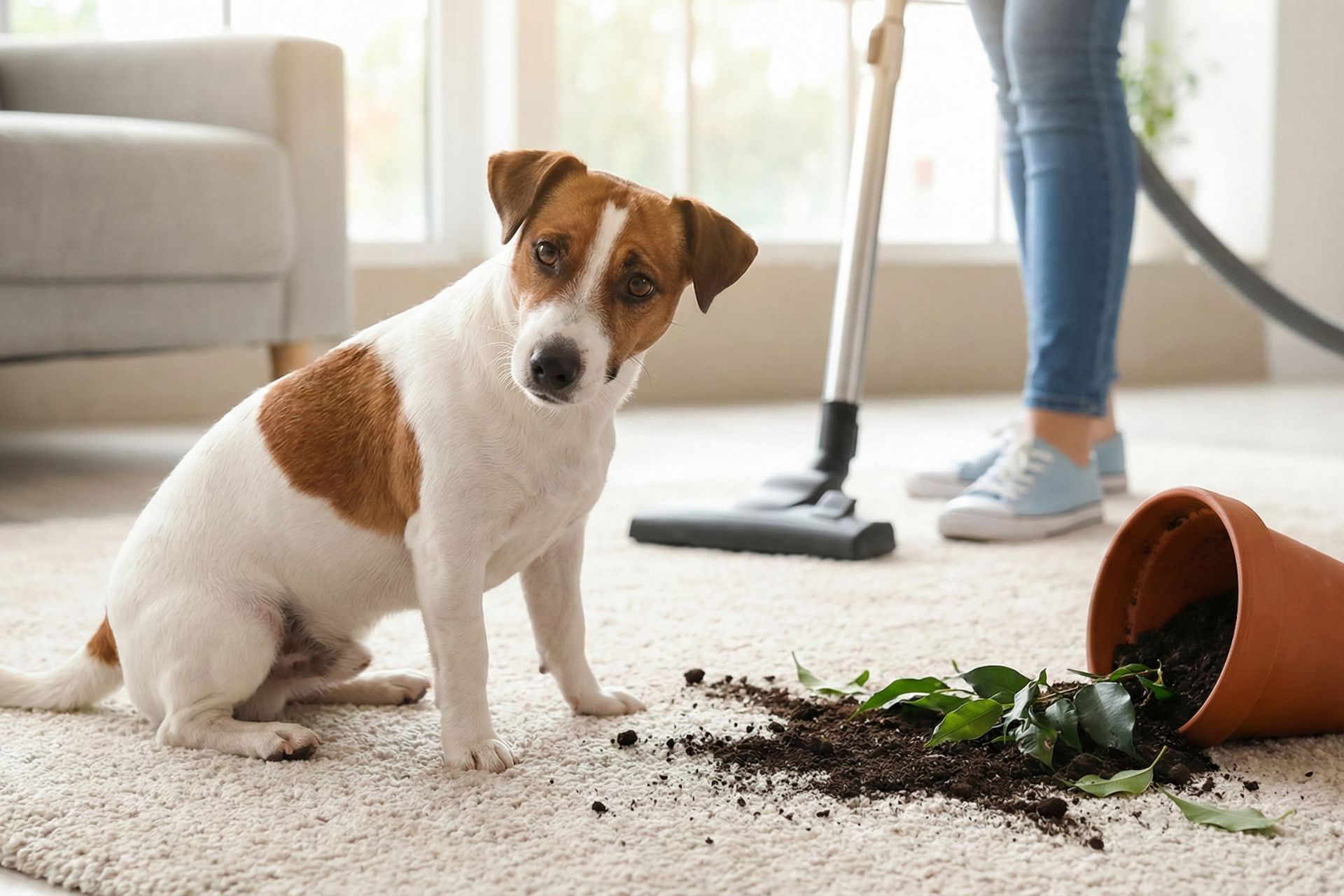

You’ve cleaned that carpet spot three times, but your dog keeps returning to the same place. The odor returns. Your family notices the smell. Guests comment. You’re considering replacing the entire carpet. But here’s what most Phoenix pet owners don’t realize: incomplete enzymatic treatment is exactly why your dog keeps marking that spot. Dogs follow scent trails to re-mark territory where ANY residual odor remains. Your DIY attempts might actually be triggering the repeated urination behavior instead of stopping it.
Key Information
Professional enzymatic treatment eliminates pet urine odors permanently by breaking down the chemical compounds causing the smell, preventing repeat marking behavior. IICRC-certified technicians use UV blacklight detection to find 100% of urine deposits (many invisible to the naked eye) and professional-grade extraction equipment reaching carpet padding and subfloor where DIY rental equipment cannot. Phoenix’s extreme summer heat (110°F+) accelerates uric acid crystal odor concentration, making professional treatment critical. Eco-friendly, non-toxic enzymatic solutions are safe for children and pets while delivering superior results to DIY store products or steam cleaning methods.
Overview
Professional pet odor removal in Phoenix requires fundamentally different approach than generic cleaning advice. Arizona’s extreme summer temperatures accelerate urine odor concentration through uric acid crystal activation. Pet allergen accumulation (affecting 10-30% of Phoenix residents) demands complete enzymatic breakdown rather than surface cleaning. Repeat dog marking behavior—triggered specifically by incomplete odor removal—requires professional UV detection and deep extraction that DIY equipment cannot achieve.
This guide provides evidence-based solutions for Phoenix pet owners struggling with recurring odor problems, frustrated DIY failures, and ongoing repeat urination. Understanding enzymatic treatment science, repeat marking behavior psychology, professional extraction requirements, and Arizona climate factors helps pet owners make informed decisions between DIY attempts and professional solutions.
Understanding Why Your Dog Keeps Peeing on the Same Spot
 Dogs mark territory at spots where they detect ANY residual scent, even microscopic amounts humans cannot smell. Canine olfactory sensitivity is 10,000-100,000 times more sensitive than human smell, allowing dogs to detect urine compounds in concentrations far below human perception levels. When DIY enzymatic cleaning leaves urine compounds in carpet padding or subfloor, your dog’s sensitive nose detects the remaining scent as a territorial marker.
This residual scent actually triggers repeat marking rather than preventing it. Your dog experiences the incomplete cleaning as a signal to reinforce territory marking at that location. Each time your dog re-marks the spot, the behavioral pattern strengthens, creating a cycle of continued urination even after multiple cleaning attempts. The psychological connection becomes behavioral reinforcement—your dog returns to the same location repeatedly.
Professional complete enzymatic elimination breaks this cycle by removing ALL urine compounds your dog can detect. When enzymatic treatment reaches carpet backing, padding, and subfloor, and breaks down carbamide and uric acid molecules completely, your dog no longer detects territorial markers. Without residual scent triggers, repeat marking behavior stops.
Professional UV Detection Prevents Repeat Marking Triggers
UV blacklight reveals urine deposits invisible to the naked eye—many pet owners have cleaned visible spots while missing hidden contamination elsewhere. Professional IICRC-certified technicians systematically scan entire rooms with UV detection, revealing every urine location. This complete detection prevents overlooked spots that continue causing repeat marking behavior despite treatment attempts.
How Enzymatic Treatment Actually Eliminates Odors
 Pet urine contains three main odor-causing compounds: carbamide, uric acid, and ammonia. Enzymatic cleaners contain specific enzymes—protease, lipase, and amylase—each targeting different molecular bonds. Protease breaks protein bonds (carbamide molecules), lipase breaks fat bonds (urine fatty acids), and amylase breaks starch bonds (urine starches). This molecular-level breakdown converts odor-causing compounds into harmless water, carbon dioxide, and other simple substances.
This is fundamentally different from fragrance masking. DIY enzymatic products often contain only single enzyme types, providing incomplete breakdown. Professional formulations contain multiple enzyme types ensuring complete coverage of all urine compound types.
Contact Time Requirements Differ for Fresh vs Old Stains
Fresh urine stains require 10-15 minutes* of enzyme contact time for sufficient breakdown. Old dried stains (months or years old) require 24-48 hours* enzyme contact because uric acid crystals become highly concentrated in dried urine. This extended contact time allows enzymatic molecules adequate time to break down crystallized compounds completely.
Professional applications allow proper contact time before extraction, whereas DIY “spray and wipe” approaches don’t permit sufficient enzyme reaction time. This timing difference explains why many DIY attempts fail—the enzymatic reaction cannot complete without adequate contact duration.
All service timelines and pricing ranges are provided for general information only. Actual service duration and costs will depend on the specific cleaning needs, surface condition, square footage, and agreed-upon scope of services as set forth in the written service agreement.
Professional Extraction Reaches Where DIY Equipment Cannot
Urine soaks past carpet surface into backing, padding, and subfloor—often 12+ inches deep. Professional truck-mounted extraction equipment operates at 1200 psi extraction power, reaching deep into carpet layers to saturate enzymatic treatment throughout contamination zones. Consumer rental equipment typically provides 600 psi—insufficient for deep padding and subfloor extraction.
Professional moisture meter verification ensures complete extraction, preventing mold growth that creates secondary odor problems. Incomplete extraction leaves urine-saturated padding, which continues harboring odor and providing environmental trigger for repeat marking behavior.
Common DIY Mistakes That Worsen Pet Odors
DIY carpet cleaning attempts frequently create worse problems than the original odor. Understanding these mistakes helps homeowners recognize when professional intervention becomes necessary.
Why Steam Cleaning Actually Worsens Pet Urine Odors
Steam and heat activate uric acid crystals in dried urine, vaporizing volatile odor compounds. This heat activation creates more concentrated, potent odor immediately after steam treatment—explaining homeowner perception that “steam made it worse” (because it did). Long-term consequence: heat pushes urine deeper into carpet padding and subfloor, spreading contamination beyond original area.
This is why IICRC professional standards specifically recommend against steam cleaning for pet urine treatment. Professional low-moisture enzymatic extraction avoids this heat activation problem entirely.
High-pH Cleaners Can Permanently Set Odors
Ammonia and vinegar are high-pH solutions that can create chemical reactions with uric acid compounds, chemically binding odor molecules together. Result: enzymatic treatment cannot break chemically-bound compounds because the molecular structure has changed. Wrong cleaner selection transforms fixable odor problems into unsolvable situations.
Many DIY product labels don’t clearly indicate pH levels, making it easy to select inappropriate cleaners by mistake. Professional product selection prevents this permanent damage scenario.
Oversaturation Creates Secondary Mold Problems
Excessive water saturation during DIY attempts creates mold growth, generating new odor problem beyond original pet urine. Padding remains wet longer (slower drying), extending mold risk. Professional moisture management prevents oversaturation, using proper water quantities and equipment to achieve appropriate extraction levels.
Professional IICRC Certification & Standards
 IICRC (Institute of Inspection, Cleaning & Restoration Certification) is the industry-recognized organization establishing professional cleaning standards. IICRC certification standards require comprehensive two-day training programs covering fiber identification, cleaning chemistry, equipment operation, and safety protocols.
S100 Pet Stain Protocol Establishes Professional Procedures
The IICRC S100 Standard specifically establishes professional procedures for pet stain and odor removal. Protocol requirements include systematic UV detection methodology, enzymatic treatment contact time specifications, extraction standards ensuring complete moisture removal, pH testing and cleaner selection guidelines, and safety procedures for enzyme handling.
Professional compliance with S100 ensures optimal results through evidence-based procedures. Barefoot’s IICRC-certified technicians follow these protocols systematically, differentiating professional service from uncertified cleaning companies.
Ongoing Professional Development & Training
Certified technicians maintain professional credentials through continuing education requirements. Ongoing training covers new enzymatic formulations, emerging equipment technologies, safety advances, and refined techniques. This commitment to professional development ensures Barefoot technicians remain current with industry best practices.
Phoenix Heat Activation & Arizona Climate Factors
Phoenix’s extreme summer temperatures create unique pet odor challenges not experienced in cooler climates. Understanding Arizona climate impact helps explain why professional treatment timing and methodology prove critical.
Heat-Activated Uric Acid Crystal Odor Concentration
Phoenix summer average temperatures reach 110°F+, the highest sustained temperatures in the United States. Heat accelerates uric acid crystal decomposition and odor release, vaporizing volatile compounds. In Phoenix’s dry climate, moisture that would dilute odor molecules remains absent, leaving odor compounds highly concentrated in air.
Result: Phoenix pet odor problems intensify significantly during summer months compared to national averages. Professional treatment during heat season becomes particularly critical—waiting allows heat-activated odors to become deeply embedded and more difficult to eliminate.
Seasonal Pet Accident Patterns in Phoenix
Summer heat keeps pets indoors more extensively (air conditioning reliance), increasing indoor urine accidents with extended indoor confinement. Winter sealed-house months concentrate pet allergens indoors (10-30% of Phoenix residents suffer pet allergies experience amplified symptoms). Professional seasonal scheduling recommendations address these patterns.
Cost Comparison—Professional vs DIY vs Replacement
Understanding true cost comparisons—including DIY failure scenarios—helps property owners make informed financial decisions. Transparent cost analysis reveals professional treatment ROI.
Professional Enzymatic Treatment Pricing
Professional enzymatic pet odor treatment typically ranges from $50-150 per room*.
All service timelines and pricing ranges are provided for general information only. Actual service duration and costs will depend on the specific cleaning needs, surface condition, square footage, and agreed-upon scope of services as set forth in the written service agreement.
Average 3-room house professional investment: $150-450*. Professional service includes UV detection, enzymatic treatment with appropriate contact time, professional-grade extraction, and satisfaction guarantee backing all work.
DIY Equipment Rental True Cost Analysis
Equipment rental costs $50-75 per day*, DIY cleaner products $20-50*, appearing as $70-125* total DIY investment. Reality: DIY carpet cleaning failure rate reaches 60-70% according to professional restoration data. Average DIY failure damage costs $500-1,500* requiring professional correction.
Realistic DIY total cost when failure occurs: $570-1,625* (substantially exceeding professional treatment). Professional treatment cost avoidance: saves $400-1,500*+ over entire project lifecycle.
Carpet Replacement Cost Reality
Comparable carpet replacement for typical Phoenix home ranges from $5,000-15,000*+. Labor costs for removal and installation add $500-2,000*. Total replacement investment: $5,500-17,000*+.
10-year cost comparison: Professional maintenance averaging $500-1,500* versus replacement cycle $10,000-20,000*+. Professional treatment ROI saves $5,000-15,000*+ over furniture lifespan, presenting clear financial advantage over replacement approach.
Professional Equipment & Technology Advantages
Professional equipment specifications differ dramatically from consumer rental machines, explaining superior results professional services achieve.
Truck-Mounted Professional Equipment vs Consumer Rental
Professional truck-mounted equipment provides 1200 psi extraction power and 200°F+ water temperature. Rental equipment typically offers 600 psi with inconsistent heating. Professional extraction depth reaches carpet backing, padding, and 12+ inches into subfloor. Rental equipment depth reaches surface only, leaving urine in padding.
Professional moisture meter verification prevents oversaturation creating mold. Rental equipment lacks moisture verification, increasing mold risk. Professional efficiency completes typical home in 2-4 hours*, while DIY attempts require 6-8+ hours* of manual effort. Equipment differences directly explain why professional achieves superior results.
UV Blacklight Detection & Hidden Stain Technology
Professional UV blacklight (365nm wavelength) reveals urine deposits invisible to naked eye. Many spots remain undetected by homeowner observation. Professional systematic detection finds spots homeowners missed or didn’t know existed. Complete detection prevents overlooked spots causing repeat marking triggers.
Professional IICRC protocol: full room UV scan before treatment begins. DIY homeowner attempts proceed blind—unable to detect hidden contamination. This detection capability represents professional service competitive advantage.
Pet Owner Concerns—Safety, Family Health & Eco-Friendly Solutions
Professional enzymatic treatment addresses legitimate family safety concerns with credible eco-friendly solutions.
Pet & Child Safety of Professional Enzymatic Treatment
Professional enzymatic cleaners feature non-toxic, biodegradable formulations—no harsh chemical residues remain after treatment. Pets won’t experience paw irritation during or after treatment. Children won’t encounter respiratory irritants or skin irritation. Families and pets access treated areas immediately after curing (no off-gassing period).
Professional product selection ensures safety certifications backing claims. DIY store products offer variable safety with unclear ingredient transparency.
Health Benefits Beyond Odor Removal
Complete enzymatic treatment removes allergen sources (pet dander proteins in urine). Indoor air quality improves measurably post-cleaning. Research indicates 10-30% of people with pet allergies experience symptom reduction after professional enzymatic treatment. Respiratory health benefit for asthma-sensitive family members represents genuine health investment beyond cosmetic cleaning.
Arizona winter sealed-house months concentrate pet allergens indoors—professional treatment improves respiratory wellness during high-allergen season. Health angle differentiates professional cleaning from simple odor masking.
When to Call a Professional vs DIY Attempt Decision Framework
Certain situations clearly warrant professional intervention rather than additional DIY attempts.
Fresh Accident Immediate Response Window
Fresh urine accidents benefit from immediate professional response (within 24 hours*). Enzymatic treatment proves most effective on recent stains. Quick professional extraction prevents deep padding saturation. Cost proves lower for fresh treatment versus old stain remediation.
Barefoot emergency same-day service* prevents worst-case damage progression, stopping repeat marking cycle before behavioral reinforcement strengthens.
Repeat Problem & Multiple Failed DIY Attempts
Failed DIY attempts indicate incomplete enzymatic treatment. Repeat marking behavior signals ongoing problem requiring professional intervention. UV detection finds spots DIY missed. Professional complete extraction reaches all contamination. Professional success addresses situations where DIY repeatedly fails.
Old Dried Urine & Chronic Odor Issues
Months or years-old urine contains highly concentrated uric acid crystals—DIY enzymatic treatment proves insufficient for remediation. Professional extended enzymatic treatment (24-48 hours* contact time) becomes necessary. Subfloor saturation sometimes requires padding replacement. Professional assessment determines fixability versus replacement-only scenarios.
Barefoot Clean Floors Advantage—IICRC Certified, Eco-Friendly, Phoenix Expert
Professional distinction stems from certified expertise, eco-friendly commitment, local market knowledge, and service responsiveness.
Barefoot’s IICRC Certification & Professional Credentials
Barefoot technicians hold IICRC Carpet Cleaning Technician certification with professional training in S100 Pet Stain Protocol. Ongoing professional development maintains current certifications and introduces new techniques. Equipment maintenance and calibration verification ensures reliable performance. Professional standards compliance demonstrates commitment to industry best practices.
Eco-Friendly, Pet-Safe, Family-Safe Solutions
Non-toxic enzymatic formulations keep kids and pets safe. Biodegradable solutions reflect environmental responsibility. Professional product selection matches specific cleaning needs. Health-first approach prioritizes family wellness. Certified eco-friendly products provide transparent ingredient disclosure. Values alignment with eco-conscious families differentiates service positioning.
Phoenix Climate Expertise & Local Market Knowledge
Years serving Phoenix pet owners and businesses establish deep understanding of Arizona heat activation odor challenges. Seasonal scheduling recommendations address summer peaks and winter allergen concentration. Local allergen knowledge (10-30% of residents with dust allergies) informs service protocols. Community reputation reflects responsive, reliable service.
Same-Day & Emergency Service Commitment
Emergency same-day service* addresses urgent pet accident situations. Flexible scheduling accommodates weekend and evening needs. Rapid professional response prevents worst-case damage progression. 24/7 availability serves critical urgent needs. Professional commitment prioritizes customer urgency and community responsiveness.
Frequently Asked Questions About Pet Odor Removal
Q: Why does my dog keep peeing on the same spot even after professional cleaning?
Typically because incomplete enzymatic treatment left residual odor. If enzymatic treatment didn’t reach all contamination in padding and subfloor, your dog’s sensitive nose detects remaining urine compounds. Professional IICRC-certified treatment with UV detection and deep extraction prevents repeat marking by completely eliminating all urine compounds.
Q: How long does enzymatic treatment take to work?
Fresh stains: 10-15 minutes* contact time typically sufficient. Old dried stains: 24-48 hours* enzyme contact required (uric acid crystals need extended time). Professional applications allow proper contact time before extraction. DIY “quick spray and leave” doesn’t permit enzymes sufficient time to break down all compounds.
Q: Why does steam cleaning make pet urine smell worse?
Heat activates uric acid crystals in dried urine, vaporizing odor compounds and making smell stronger immediately. Long-term consequence: heat pushes urine deeper into padding and subfloor. Professional low-moisture enzymatic extraction avoids this mistake entirely.
Q: Are ammonia and vinegar good for pet urine?
No—they’re problematic. High-pH ammonia can chemically bind urine compounds, making odors permanent and enzyme-resistant. Vinegar (acidic) can set odors through different chemical reactions. Wrong pH cleaners transform fixable problems into unsolvable situations. Professional pH-neutral enzymatic treatment prevents permanent damage.
Q: What’s the difference between enzymatic cleaners and regular carpet cleaners?
Enzymatic cleaners break chemical bonds of urine compounds (carbamide, uric acid, ammonia), converting them to harmless water and CO2. Regular cleaners remove surface liquid only—providing temporary masking without addressing underlying cause. Enzymatic treatment provides permanent elimination; regular cleaning just masks odor temporarily.
Q: Is professional pet odor removal worth the cost compared to replacement?
Absolutely. Professional treatment: $50-150 per room*. Carpet replacement: $5,000-15,000*+. DIY failure damage: $500-1,500*. Over 10 years, professional treatment costs $500-1,500* versus replacement cycle $10,000-20,000*+. Professional ROI saves $5,000-15,000*+ over furniture lifespan.
All service timelines and pricing ranges are provided for general information only. Actual service duration and costs will depend on the specific cleaning needs, surface condition, square footage, and agreed-upon scope of services as set forth in the written service agreement.
Q: Does Phoenix’s heat make pet odor problems worse?
Yes, significantly. Phoenix 110°F+ summers activate uric acid crystals, vaporizing odors and concentrating scents. Heat-activated odors prove stronger than any other US market. Winter heating compounds problem. Phoenix summer peaks create 30-40% odor intensity increase versus cooler climates. Professional treatment proves critical during extreme heat months.
Q: Is professional pet odor removal safe for kids and pets?
Yes. Professional enzymatic treatments are non-toxic, biodegradable, pet-safe formulations. No harsh chemical residues remain. Kids and pets access treated areas immediately. Professional product selection ensures safety certifications. Eco-friendly approach prioritizes family wellness.
Q: Can professional cleaning help with pet allergies?
Yes. Complete enzymatic treatment removes allergen sources (pet dander proteins in urine). Improved air quality reduces allergy symptom intensity. 10-30% of people with pet allergies experience relief post-professional cleaning. Arizona winter sealed-house months amplify allergen concentration—professional treatment improves respiratory health during high-allergen season.
Q: What is IICRC certification and why does it matter?
IICRC (Institute of Inspection, Cleaning & Restoration Certification) establishes professional standards. Carpet Cleaning Technician (CCT) certification requires two-day training in cleaning chemistry, equipment operation, pet stain protocols (S100 Standard). Certified technicians follow proven procedures. Professional distinction from uncertified competitors. Barefoot’s IICRC-certified technicians ensure industry-standard service quality.
Q: How do professionals find urine stains I can’t see?
UV blacklight technology reveals urine deposits invisible to naked eye. Professional 365nm UV wavelength illuminates all urine spots. Systematic detection ensures no spots missed—preventing repeat marking triggers. Professional capability represents competitive advantage (DIY homeowners attempt blind).
Emergency Service & Same-Day Response Availability
Professional commitment to urgent situations distinguishes responsive service providers from standard cleaning companies.
Same-day service availability* addresses emergency pet accidents. Response within 4-6 hours* prevents urine deep saturation in carpet padding and subfloor. Rapid enzymatic treatment stops repeat marking behavior formation before psychological reinforcement strengthens. Barefoot’s urgent pet owner needs commitment prioritizes prevention of worst-case damage progression.
Weekend and evening service options accommodate busy family schedules. Responsive professional approach recognizes that pet accidents don’t follow business hours. Community-focused service ethic drives flexible scheduling ensuring access when urgent situations arise.
Conclusion: Professional Pet Odor Elimination for Phoenix Families
Professional enzymatic treatment in Phoenix requires IICRC-certified expertise, UV detection technology, and deep extraction equipment exceeding DIY capabilities. Barefoot Clean Floors’ trained and certified technicians understand Arizona’s unique heat-activated odor chemistry and repeat marking behavior psychology creating endless cycles without professional intervention.
Complete enzymatic breakdown of urine compounds (not fragrance masking), combined with eco-friendly, non-toxic solutions safe for families and pets, delivers permanent odor elimination. Professional investment ($50-150 per room*) prevents DIY failure damage ($500-1,500*+) and costly carpet replacement ($5,000-15,000*+). Repeat marking behavior prevention through complete odor elimination stops the cycle before behavioral patterns strengthen.
Phoenix climate expertise and emergency same-day service* availability address urgency pet owners experience. 100% customer satisfaction guarantee backs all work with professional confidence.
Ready to eliminate pet odors permanently and stop repeat marking behavior?
Contact Barefoot Clean Floors for professional pet odor removal and stain treatment:
-
Phone: (602) 603-4781
-
Service Areas: Phoenix, Greater Phoenix Metro, Maricopa County
-
Same-Day Service: Available for emergency situations*
-
100% Customer Satisfaction Guarantee
Schedule your free professional assessment today. IICRC-certified technicians evaluate your specific pet odor situation, explain treatment options, and provide transparent pricing. Emergency same-day service* handles urgent pet accidents. Professional enzymatic treatment prevents expensive DIY mistakes and delivers permanent odor elimination your family will appreciate.
Sources
Industry Certification and Standards
-
IICRC Carpet Cleaning Technician Certification – Professional certification standards, training requirements, and pet stain protocols (S100 Standard) for industry-standard cleaning procedures
-
IICRC Standards Documentation – Professional equipment specifications, extraction techniques, and enzymatic treatment procedures for pet stain removal
Health and Environmental Authorities
-
EPA Indoor Air Quality Guidelines – Indoor allergen data, pet dander health effects, and air quality improvement through professional cleaning
-
American Academy of Allergy, Asthma & Immunology – Pet allergen prevalence data (10-30% of Americans), respiratory health impacts, and allergy management resources
Professional and Equipment Standards
-
Professional Enzymatic Treatment Research – Enzyme chemistry, carbamide and uric acid compound breakdown mechanisms, and contact time requirements for pet stain elimination
-
Equipment Manufacturer Standards – Professional truck-mounted extraction equipment specifications, pressure ratings, and moisture management protocols
Service Consultation Disclaimer
This article provides general information about professional cleaning services and should not be considered as specific service recommendations for your property. Cleaning needs, methods, and procedures vary significantly based on individual circumstances, surface types, condition levels, and specific cleaning requirements. Service schedules, cleaning timelines, and procedures can be affected by many factors specific to each property.
All service timelines and pricing ranges are provided for general information only. Actual service duration and costs will depend on the specific cleaning needs, surface condition, square footage, and agreed-upon scope of services as set forth in the written service agreement.
For free consultation and professional cleaning assessment for your specific Phoenix area property, contact Barefoot Clean Floors at (602) 603-4781 or visit Barefoot Clean Floors. Our certified cleaning technicians will provide personalized service recommendations based on your specific cleaning needs and property requirements. No service commitment is created by reading this article.
